|
|
|
Housing · The 100,000 Homes Plan
|
We Can Build 100,000
Permanently Affordable
Homes
A family in a market-rate two-bedroom pays $1.2 million more over thirty years than the same family in an affordable home. Here is where that money goes.
|
|
|
The Governor's housing plan sets a statewide target of adding 222,000 new homes to the market by 2035. And while it seems like a good thing at face value, this plan overwhelmingly favors market-rate housing (~$3,000-$3,400 per month for a one-bedroom in Medford), not affordable or public housing, at a rate of 2 to 1. I support building more housing, and I have fought for zoning reforms, the broker fee ban, and the tenant protections that make our communities more livable. But counting luxury units toward our housing goals won't help the educators, nurses, retirees, or the young families being priced out of our communities right now.
So I'm asking a different question: What would it take for Massachusetts to build 100,000 permanently affordable homes, and why is that investment worth making? To answer it, I want you to follow the money with me through one real project: 55 Hudson Street in Boston's Chinatown, where the Asian Community Development Corporation is building 110 permanently affordable homes above a new public library, on land the neighborhood lost to eminent domain generations ago and organized for decades to win back. Consider this: over thirty years, a family renting a market-rate two-bedroom will pay more than a million dollars beyond what the same family pays in an affordable home. The full answer requires understanding how housing actually gets financed, and once you see the numbers, you will never hear the phrase "affordable housing costs too much" the same way again.
|
|
The 15 to 20 Percent Return Problem
|
Private developers will not build housing unless their investors are promised a return of 15 to 20 percent per year on their capital, and this is the industry's own openly-stated standard, the hurdle rate that every project must clear before a shovel touches the ground. That return never appears in the project's construction budget because it is collected later: from tenants, in rent, month after month, for as long as the building stands.
Affordable housing, built by community development corporations, housing authorities, and mission-driven nonprofits, runs on the opposite model. The nonprofit developer's compensation is a one-time fee, capped by the state, written transparently into the budget for everyone to see, and every dollar of rent after that cycles back into the building: maintenance, reserves, resident services, and paying off debt. Rents in these homes are set so that working households, families earning around sixty percent of the area median income, pay about thirty percent of what they earn, which comes to roughly $2,100 a month for a two-bedroom in the Boston area today. This is why critics who compare per-unit construction costs are comparing the wrong numbers: the affordable model shows you its full cost up front, and the market model hides its much larger cost in thirty years of return on capital investment, or in other words, your rent.
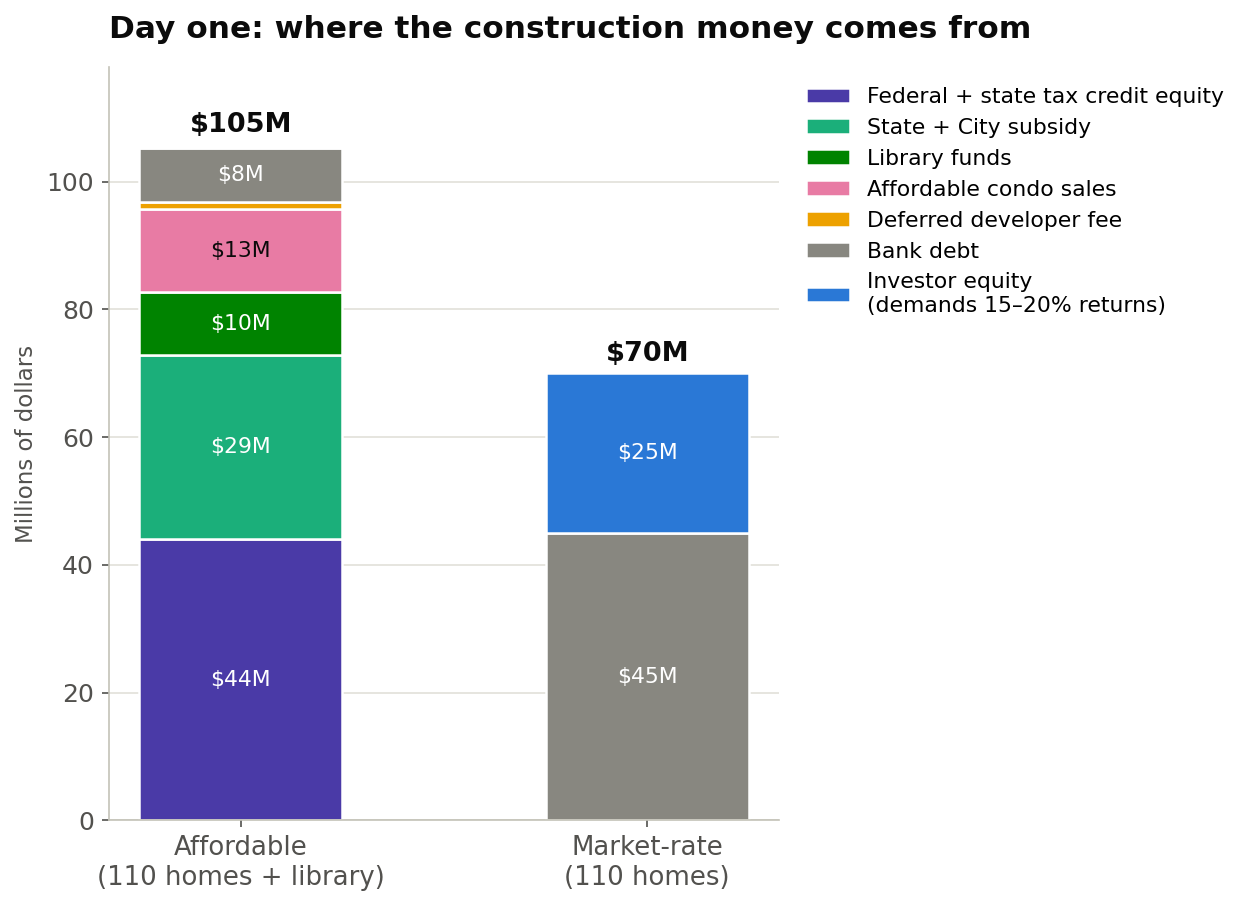
As an example, to build 110 homes and a library in Chinatown, 55 Hudson Street assembled roughly $105 million from nine separate sources, including federal and state housing tax credits, state and city subsidy, and affordable condominium sales. A market-rate developer builds comparable units with just two sources: a bank loan and investor equity demanding 15 to 20 percent returns.
|
|
|
Follow the Money for Thirty Years
|
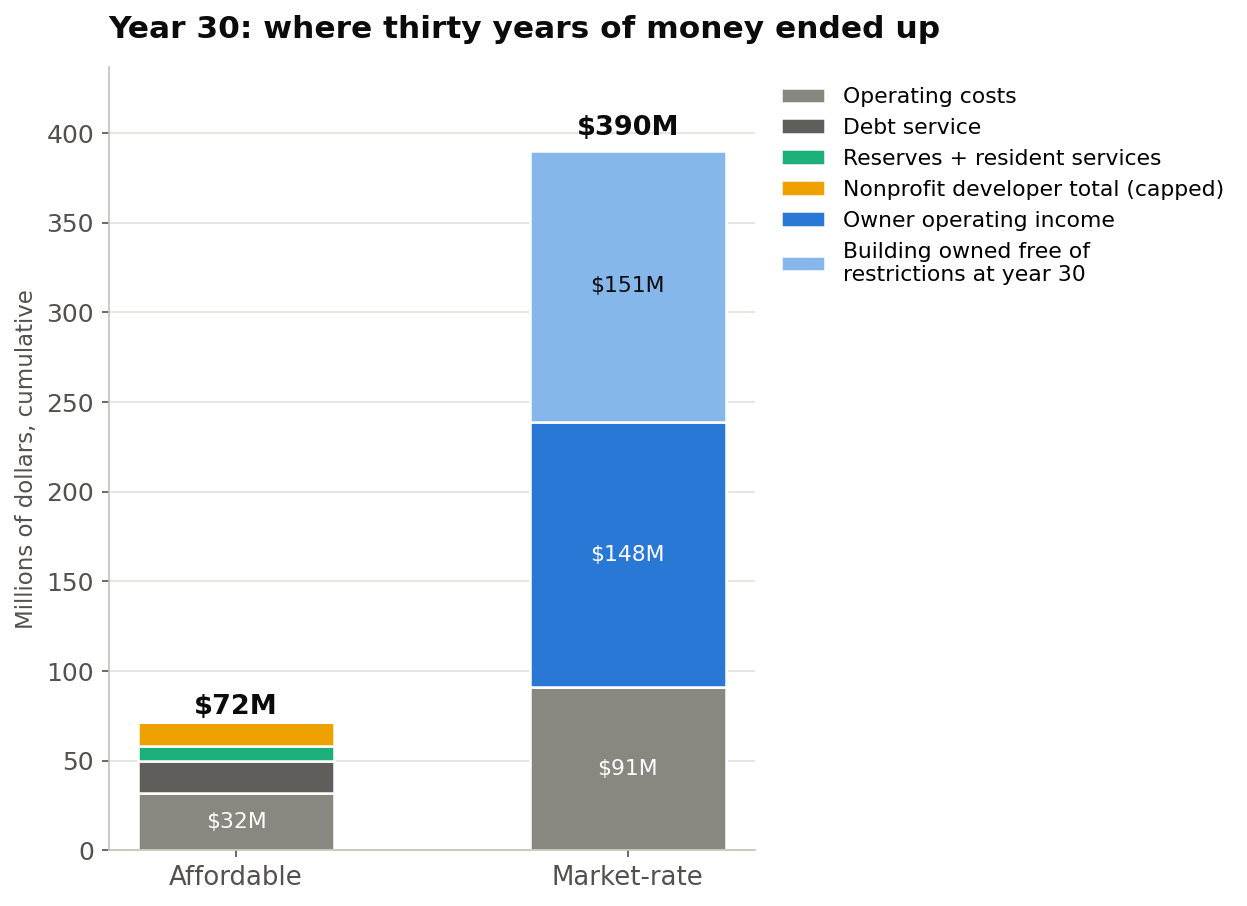
On day one, the affordable project looks expensive and complicated, and that is exactly where the industry wants the conversation to end. Follow the same two buildings for thirty years and the picture inverts completely.
|
|
|
Over thirty years, nearly everything the affordable building collects cycles back into the building itself. The market-rate building generates roughly $390 million in rent and asset value over thirty years, with roughly $300 million of it, the operating income and the building itself, landing with the owners, extracted from tenants paying nearly double the rent.
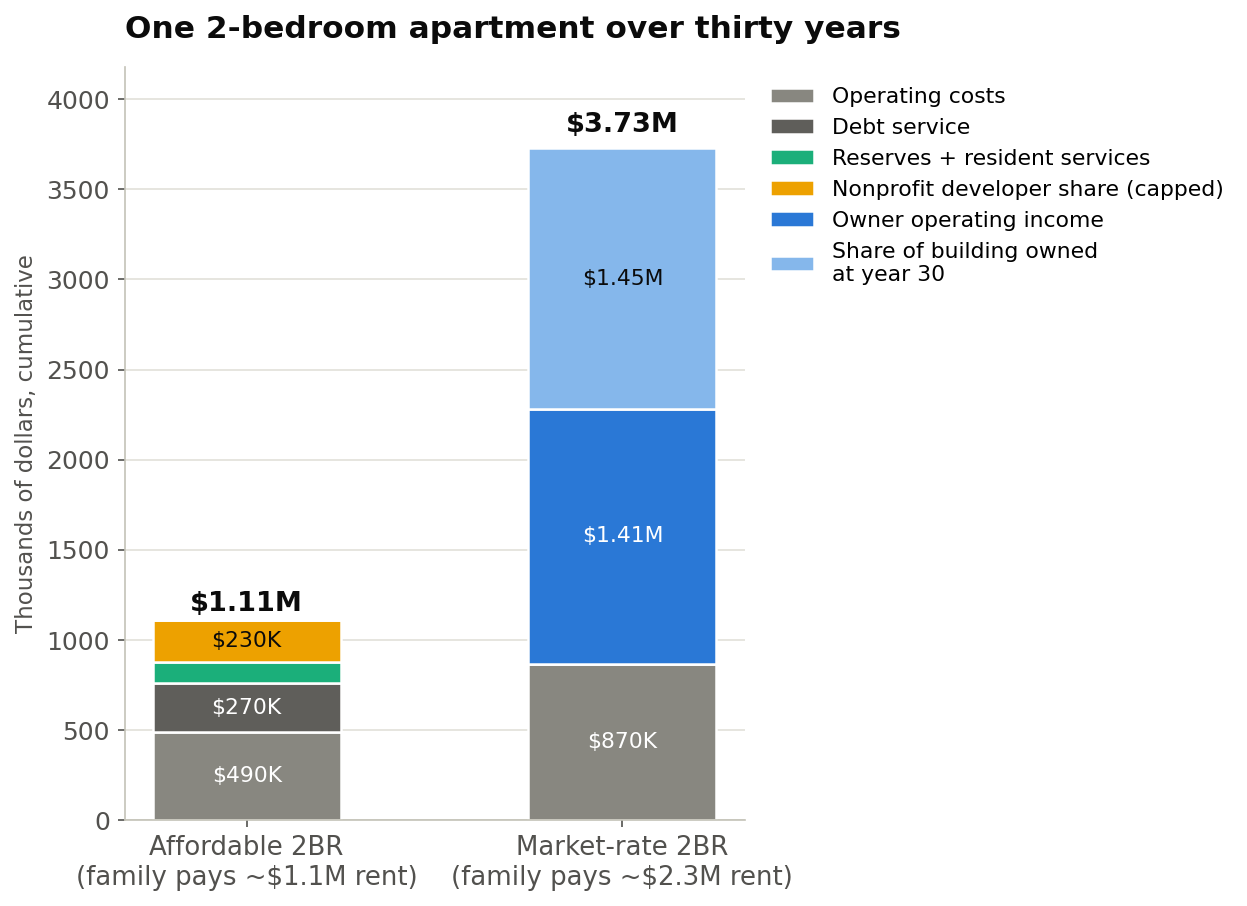
Now look at what this means for a single family in a single two-bedroom apartment.
|
|
|
A family in the affordable two-bedroom pays about $1.1 million in rent over thirty years. The same family in the market-rate two-bedroom pays about $2.3 million, and the extra $1.2 million is the price of the developer's required return. The nonprofit's total take from that unit is capped at roughly $230,000, while the market owner extracts nearly $2.9 million.
The public subsidy that built the affordable apartment was roughly $660,000, paid once. In exchange, one family keeps more than a million dollars over thirty years, the apartment stays affordable for the next family and the family after that, forever, and no investor extracts a return from anyone's rent check ever again. The subsidy is not the expensive option: it is the one-time price of shutting off a permanent extraction machine.
|
|
Union Built With Net Zero Emissions
|
The affordable unit does cost more to build, and the higher cost has a reason: the state requires the affordable housing it funds to meet high energy efficiency standards and to be climate resilient, and projects like the Chinatown example, built on public land with public dollars, carry prevailing wage requirements that guarantee workers real health insurance and real pensions. But those labor protections reach only where public land or public funding triggers them, and everywhere else workers and communities must organize for project labor agreements and community benefits agreements one job site at a time, which is exactly the fight our unions have been waging across the district. Market-rate developers carry none of these standards by default: their buildings are cheaper because their workers earn less, and their tenants and our climate pay the difference. That is why I will fight to attach prevailing wage to every state housing dollar, so the labor standards in our best affordable projects become the floor for all of them.
|
|
|
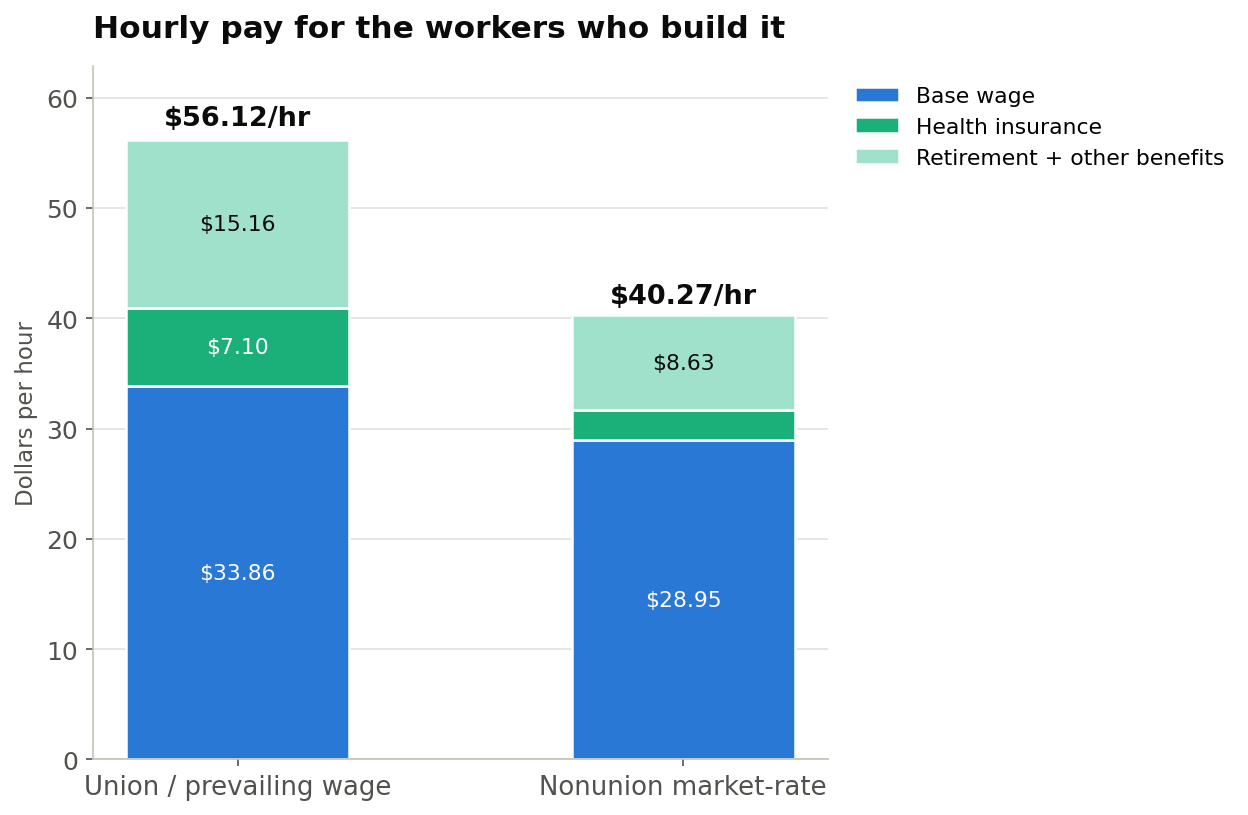
Union construction workers earn about $34 an hour in base wages plus $22 an hour in benefits, including health insurance and retirement, against about $29 an hour and $11 in benefits for nonunion workers. On a project like the Chinatown example, where prevailing wage applies, those requirements direct roughly $8 to 10 million into workers' paychecks, health coverage, and pensions that a nonunion job would convert into margin.
|
|
|
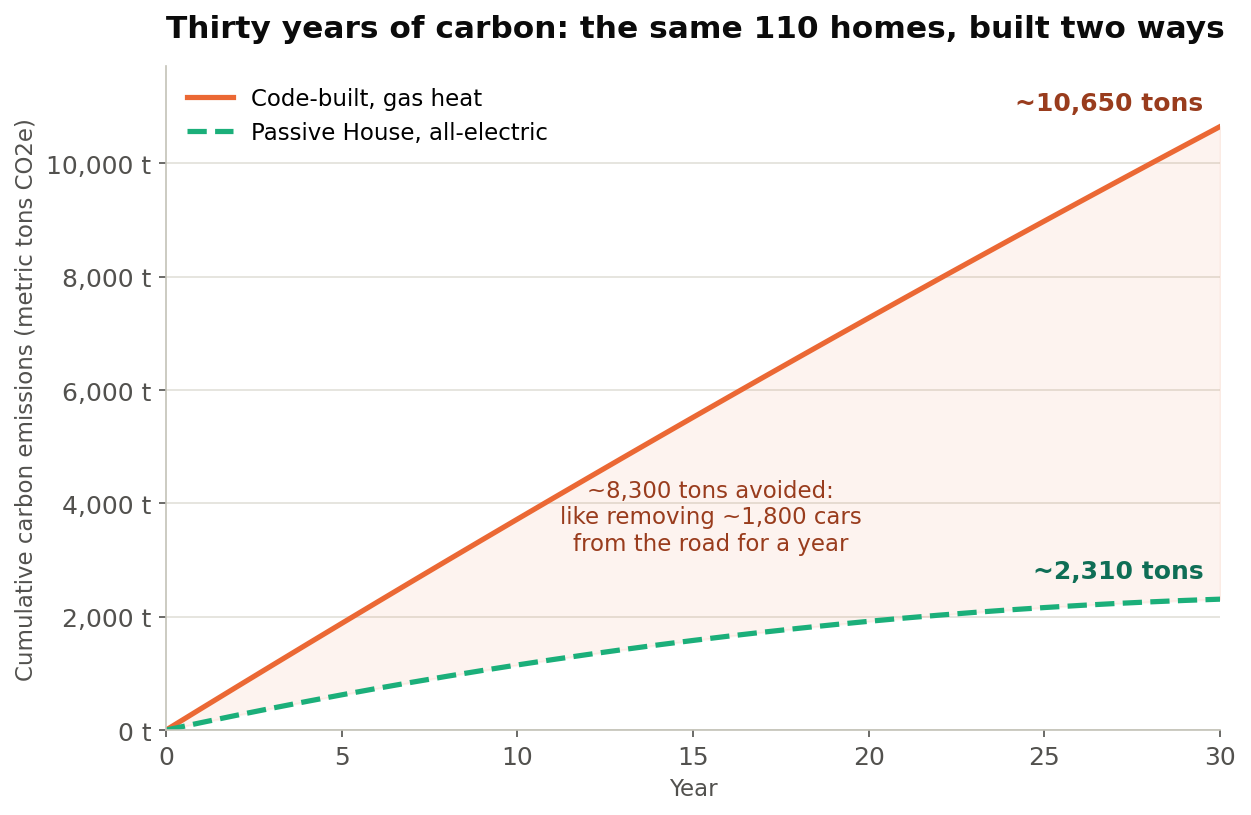
Over thirty years, a code-minimum gas-heated building of 110 units in a municipality without the specialized code emits roughly 10,600 tons of carbon. The same building constructed to Passive House standards and running on electricity emits roughly 2,300 tons, and the gap widens every year as Massachusetts cleans its electric grid. The difference is equivalent to taking about 1,800 cars off the road for a year, from one building.
And here the story connects to a fight happening right now on Beacon Hill: every city and town has a building code, the rulebook that tells builders what they must do, from fire exits to insulation. Massachusetts could write climate protection into that rulebook for the whole state, requiring every new building to run without burning gas and to waste as little energy as possible, but the real estate and development lobby has fought that requirement at every step, so the strongest climate rules remain optional and each community must vote to adopt them on its own. Where communities have adopted the stronger rules, including Boston, new large buildings already meet them, which proves the standards work, and everywhere else every new gas-heated building permitted today will keep burning gas for the next fifty years. The same industry demanding 15 to 20 percent returns from tenants is the industry keeping those rules optional for everyone else.
|
|
What 100,000 Homes Will Cost, and How We Pay for It
|
The honest number is this: building a permanently affordable home requires roughly $250,000 to $400,000 in public capital per unit depending on location. The Chinatown example sits at the very top of that range because it combines a downtown Boston site, deep affordability, homeownership units, and a public library; typical projects across Massachusetts require far less. Across 100,000 homes, that means on the order of $30 billion over a decade, or about $3 billion per year.
That sounds enormous until you place it next to what we already do. The Affordable Homes Act of 2024, which I supported, authorized $5.2 billion over five years; however, only a fraction of that authorization funds new permanently affordable construction, with much of the rest going to preserving existing public housing and to programs that support market-oriented development. We are already spending real money on housing: we are simply not spending it at the scale the crisis demands, while allowing too much of it to flow through a model that guarantees private returns instead of permanent affordability.
The Fair Share Amendment has proven we can raise revenue at this scale when we tax those most able to pay. Corporate lobbies claimed this amendment would wreak havoc on our economy, but in reality it brings in more than $2 billion every year from incomes above $1 million and funds our schools, our roads, and our public transit. A comparable commitment, funded by asking more of the largest corporations and the wealthiest households in Massachusetts and leveraged through state bonding, will finance 100,000 homes that never expire, never convert to market rate, and never send a family's rent check to an investor.
This is the housing fight I will bring to the State Senate: pairing the structural reforms that make building possible with the public financing that makes housing permanently affordable, and organizing inside and outside the building until the Commonwealth commits to homes for people over returns for investors.
|
|
|
|
Follow on Instagram
·
Follow on Bluesky
|
|
In solidarity,
Erika Uyterhoeven
State Representative, 27th Middlesex
Candidate, State Senate, 2nd Middlesex District
|
|
|
Note on sources: return requirements from standard real estate underwriting benchmarks; project figures from the publicly presented Parcel R-1 development budget; wage figures from Bureau of Labor Statistics data; energy performance from Phius certification standards and a New York City study of built Passive House multifamily projects. Thirty-year projections are illustrative models built on these sources; see the full methodology and references.
|
|
|
Facebook
·
Instagram
·
Bluesky
Paid for by Committee to Elect Erika Uyterhoeven · Somerville, MA
Contributions are not tax-deductible · $1,000 max per individual per calendar year
|
|